NoPress
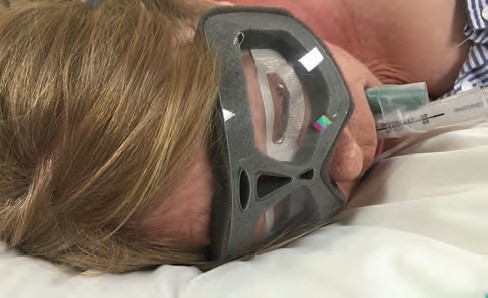
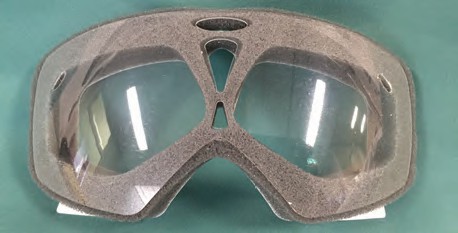
NoPress is a foam and rigid plastic shield designed specifically to protect anaesthetised patient’s eyes from externally applied pressure. It’s patented unitary design and midline flexion device means it resists a high pressure load while still conforming to the patient’s face.
Surgical Use
In many surgeries on the upper half of the body eg Ear, Nose and Throat (ORL), Dental, Maxillo-Facial, Upper Gastointestinal, Cardio-Thoracic, Neurosurgery, some Orthopaedics and Plastics or where the patient is prone or laterally positioned; there is an increased risk of accidental pressure being applied to an anaesthetised patient’s eyes(1).
Once the patient is draped, surgical retractors, head supports, surgical assistants or the surgeons themselves may lean or rest on the eyes.
By decreasing eye injuries, all practitioners, their institutions and most importantly, their patients, will benefit.
Is Shielding the Eyes from Pressure Necessary?
In upper body surgery or prone/semi-prone positioning our patients are routinely draped and we have very limited access to inspect or touch their face. To cause eye globe morbidity a large pressure may be applied for a short period or, more easily missed, is the smaller pressure which is applied over a much longer time. Clearly, applying sustained pressure on the eye is the same as the risk from glaucoma, and often an exterior pressure is greatly in excess of that which might be internally generated. This risk of pressure injury is increased as we age(2).
The ASA Closed Claim Study found that eye injuries accounted for 3% of claims against anaesthetists. These injuries were most probably due to eye opening during
anaesthesia, trauma or application of pressure to the eye(1).
The NoPress has been designed to resist very high pressures (20-22 Newtons of force(3)).
Cost and Time Efficiency
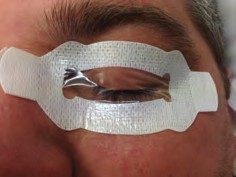
Each minute of theatre time has been estimated to cost US $664. NoPressTM comes ready to use and its non-stick tabs allow easy and rapid removal of the backing sheet before applying.
Because the shield is transparent it makes accurate positioning very easy.
Accidental pressure applied to an eye globe may cause serious morbidity or permanent blindness. Follow-up care in relation to diagnosis and management of such an injury may be time consuming, lead to increased discharge times and have major economic ramifications for all those involved.
Methods currently used to protect the eyes from pressure are sub-optimal. Many practitioners or their assistants “construct” a device from 2 eyepads and tape. This
takes time, costs money and provides a barrier to seeing the eyes and offers little protection.
There are other devices available but they often have separate compartments for each eye and this can make sizing difficult. The nature of these compartments has also led to severe eye injuries(5).
Key Features
- Thick medical grade foam is soft on patient’s face
- 3M hypoallergenic adhesive allows easy, safe application and removal
- Transparent shield allows you to see patient’s eyes
- Single shield distributes applied pressure more evenly across orbital ridges, thus reducing force per unit area
- Midline nasal flexion device and pre-curved shield ensures excellent facial conformity
- Small holes on each side prevent condensation
- Adhesive maintains position on face
- Single shield allows better fit for different face shapes and sizes
- Low profile means less likely to catch on anything
NoPress Benefits and Advantages
- Patented design that allows flexion around nose and conformity to patient’s facial shape
- Single plastic shield that transmits applied pressure around the patient’s bony orbital margins
- No sharp down-facing edges which could injure underlying tissues if pressure is applied
- Individually packaged in dust proof bag
- 2 non-stick tabs to allow easy placement, even when wearing gloves
- 3M biocompatible adhesive
- Transparent shield which allows user to see patient’s eyes
- Small holes to prevent condensation
1 Injuries associated with anaesthesia. A global perspective A. R. Aitkenhead* British Journal of Anaesthesia
95 (1): 95–109 (2005).
2 http://web.williams.edu/Astronomy/IAU_eclipses/eye_pressure.html
3 Bayly Group Formal Testing November 2015, Melbourne, Australia.
4 Shippert, RD 2005, ‘A study of time dependent operating room fees and how to save $100 000 by using
time-saving products’, The American Journal of Cosmetic Surgery, vol. 22, no 1.
5 Visual Loss in a Prone-Positioned Spine Surgery Patient with the Head on a Foam Headrest and Goggles
Covering the Eyes: An Old Complication with a New Mechanism Roth, S*; Tung, A*; Ksiazek, S†
Anesthesia & Analgesia Volume 104(5), May 2007, pp 1185-1187.